
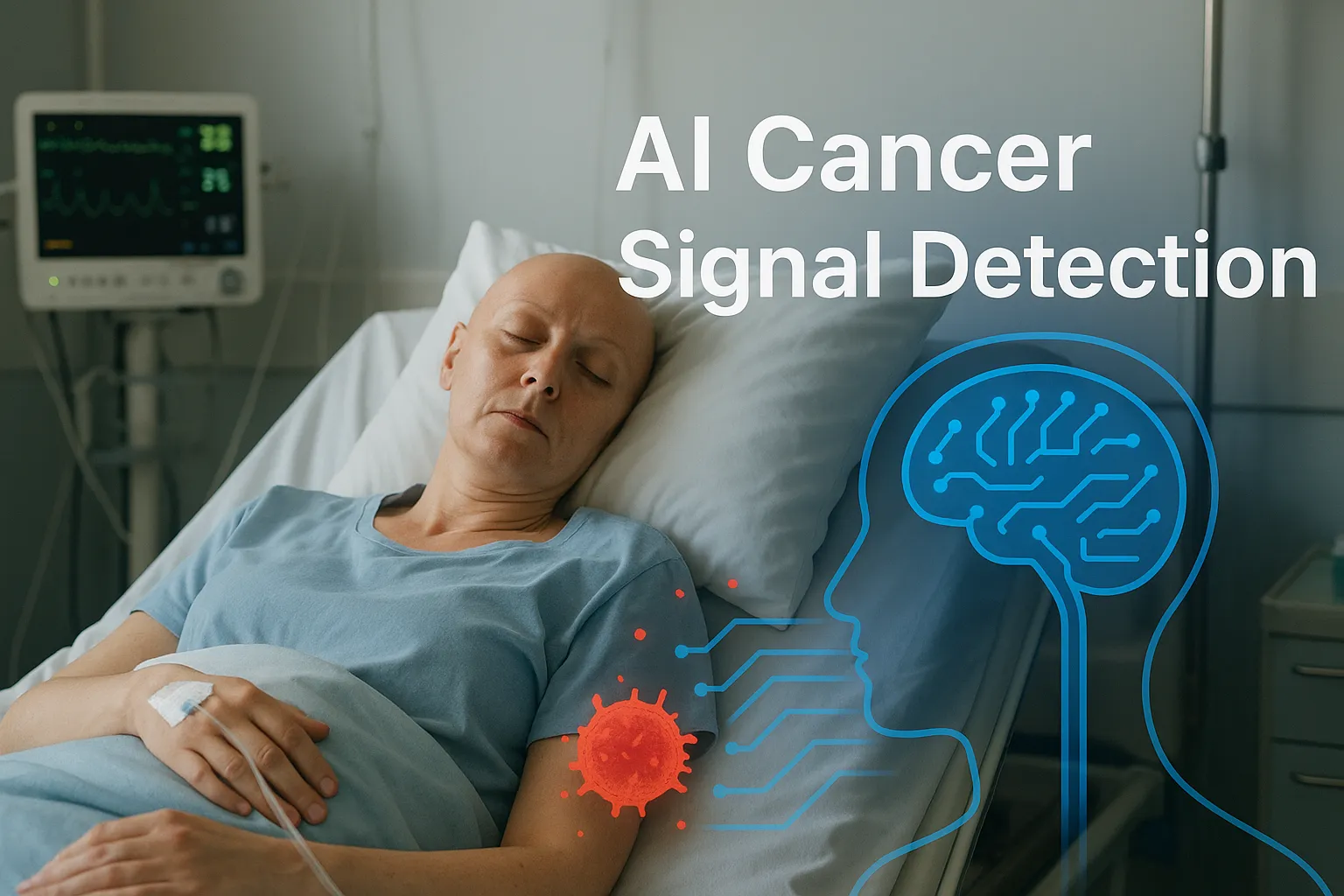
AI Cancer Signal Detection is rapidly changing how we discover cancer long before traditional tools can detect it. Scientists have long believed that early diagnosis is the key to saving lives — yet cancer remains a master of disguise, mutating and hiding in ways that make it nearly invisible in its earliest stages. With AI Cancer Signal Detection, however, researchers can now uncover molecular signals in the bloodstream that appear long before tumors form, offering a breakthrough path toward earlier intervention and more precise treatment decisions.
Why AI Cancer Signal Detection Matters for Early Diagnosis
For decades, the medical community has emphasized that early detection is the closest thing we have to a “cure.” More than 90% of cancers are solid tumors, and when these are identified early, survival rates rise dramatically — often above 90%. Yet even with advanced imaging and blood tests, the earliest stages have remained elusive.
Cancer is not just one disease. It consists of hundreds of individual diseases, each behaving differently depending on the patient, genetic factors, and tumor biology. Even two cancer cells from the same tumor can look and act differently. This complexity is one reason early detection remains difficult.
AI Cancer Signal Detection is designed to penetrate this complexity. Instead of waiting for tumors to become visible or large enough to be detected by scans, this technology searches for the molecular “whispers” that cancers release as they begin to form.
How Cancer Behaves Before Tumors Form
Traditional medical knowledge suggested that cancer begins in one location, grows, spreads to nearby tissues or lymph nodes, and only then enters the bloodstream. This belief forms the basis for today’s cancer staging system, from Stage 1 (localized) to Stage 4 (metastatic).
However, new research has revealed a startling truth:
Cancer Cells Enter the Bloodstream Far Earlier Than Expected
Studies now show that cancer cells may enter the bloodstream before a tumor becomes detectable — even at Stage 0. These early circulating cancer cells are typically:
-
Dormant
-
Rare
-
Undetectable with standard blood tests
-
Hidden within normal biological “noise”
This creates a challenge:
How do we detect something that blends in with millions of normal cells and proteins?
This is the locked door scientists have struggled to open — and where AI Cancer Signal Detection provides a breakthrough.
How AI-Based Cancer Signal Analysis Works
To understand how AI Cancer Signal Detection works, imagine the human body as a giant computer network.
-
Proteins = data packets
-
Cancer cells = malware
-
Immune system = security software
-
Protein signals from cancer = hidden messages between malicious code
Most protein messages in the bloodstream help the body function normally. But hidden among them are tiny molecular clues — the early “malware messages” cancer sends to help new tumors grow and avoid immune detection.
These subtle signals are too complex and too faint for conventional tools. But AI is uniquely capable of finding patterns and relationships within extremely noisy data.
AI Cancer Signal Detection as the Body’s New Security System
Detecting Hidden Messages From Cancer Cells
AI Cancer Signal Detection acts like a new, smarter security layer. It learns to:
-
Detect abnormal protein communication
-
Recognize patterns linked to early cancer
-
Interpret how the immune system responds
-
Identify weaknesses in the body’s defenses
-
Predict cancer development long before symptoms appear
The AI doesn’t simply identify unusual molecules — it analyzes how they interact, uncovering a sophisticated conversation that cancer uses to spread unnoticed.
Deep Proteomics and AI Cancer Signal Detection Combined
Astrin Biosciences uses deep proteomics to analyze over 9,000 proteins from a single blood sample. Combining this with AI enables:
-
High-resolution detection of molecular anomalies
-
Interpretation of protein behavior across systems
-
Identification of signals often missed by traditional blood tests
-
Detection at the earliest possible molecular stage
This level of insight creates a far more detailed understanding of cancer than current screening tools provide.
Predicting Cancer’s Future Using AI Cancer Signal Detection
Early detection is only one part of the equation. AI Cancer Signal Detection can also help determine:
-
Whether a cancer will become aggressive
-
Whether a tumor requires immediate treatment or close monitoring
-
How likely a patient is to experience recurrence
-
Which biological pathways the cancer is activating
-
Whether certain therapies will be effective
By learning from thousands of protein signatures, the AI can predict how cancer will behave long before it fully develops.
This represents a major shift:
From reacting to cancer → to predicting cancer’s future behavior.
AI vs. The World vs. Cancer
AI continues to provoke debate around issues such as safety, privacy, and the concept of “p(doom),” the probability that AI will cause catastrophic harm. But in medicine — especially cancer detection — the opposite is happening.
Here, “p(doom)” has a new meaning:
p(doom for cancer) — The Probability of Cancer Being Defeated
In cancer research, the probability of AI contributing to a breakthrough is rising. AI researcher Gary Marcus captured this sentiment when he said that a meaningful AI achievement is one that “makes a significant dent on cancer.”
AI Cancer Signal Detection is already doing that.
Future Possibilities Through AI Cancer Signal Detection
The implications for the future of healthcare are immense:
-
Earlier detection means earlier treatment
-
Earlier treatment means higher survival
-
Better predictions mean personalized care
-
Fewer missed diagnoses mean fewer late-stage cancers
This technology moves us toward a world where cancer is discovered at the molecular stage, long before it becomes dangerous.
Explore more groundbreaking insights in our AI Healthcare Innovation Guide.
- Visit our Early Diagnosis Resource Center for deeper knowledge on emerging medical technologies.
- National Cancer Institute – authoritative source for cancer statistics, research, and prevention insights.
- MIT Biological Engineering – cutting-edge developments in biomedical AI and scientific innovation.
- Harvard Medical School – leading research on advanced cancer detection and precision medicine.
Conclusion
Cancer has always been elusive — constantly shifting, mutating, and hiding in plain sight. But with AI Cancer Signal Detection, the earliest molecular signs are finally within reach. This technology reveals the hidden protein messages cancer uses to grow, evade the immune system, and spread.